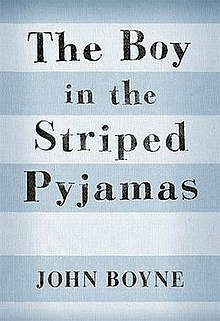
This blog post will be about the well-known book The Boy in the Striped Pyjamas, written by John Boyne. Like many people, I have seen the movie adaptation, but that does not take away the fact that I am actually interested to read this book. The impactful story of Bruno and his new friend Shmuel has left multiple hearts broken.
Before going into the analysis of the book I am going to talk about the theme crossover first. I never heard this term before and after doing some research, I am perplexed at how common it is. I never learned about this at school, which is a shame. Crossover stories contain elements that are as relevant to two different age groups. For example, in this story, the end is much more logical for adults who realize what is happening faster than for teens. Adults will instantly know that Bruno and Shmuel entered a gas chamber because they know that this really happened in history. Teens often do not know this yet, therefore they may have a harder time understanding what is really happening and will probably think that they just went somewhere to not be found. Children often focus more on friendship and the positive and fun parts where adults focus more on the darker and negative parts. Since adults have a broader understanding of the world and obtained more knowledge on the Second World War, they tend to automatically focus on aspects regarding that more. Adults will read this story as a serious novel whereas children or preteens will read it as a book about an unexpected friendship.
This story follows a boy named Bruno who lives in a German household. His father is a commandant in the German army and lives under the ruling of Hitler. When Bruno’s father, Ralf, moves his family to Auschwitz, where he is in charge of the camp, Bruno explores the forest beside his house. When go goes further than he should, Bruno stumbles upon a fence and meets a boy named Shmuel. The two form an unexpected bond. Bruno does not understand that Shmuel is actually a Jewish boy who is in a concentration camp, he only sees a new friend to play with. Bruno is a very naïve and innocent boy, he does not know much because he is isolated and he does not understand why did father is unfair. While playing with Shmuel the reader gets to see that Bruno is a caring and generous boy.
Shmuel on the other hand is very smart and sees life for what it really is. He understands that he and all the other Jewish people are being locked up. He also understands that he cannot get out whereas Bruno does not. When talking about where Bruno is from Shmuel becomes in awe of Bruno, because he can go wherever he wants, Berlin for example.
‘’‘I’ve never been to Berlin,’ said Shmuel.
‘And I don’t think I’d ever been to Poland before I came here,’ said Bruno, which was
true because he hadn’t. ‘That is, if this really is Poland.’
‘I’m sure it is,’ said Shmuel quietly. ‘Although it’s not a very nice part of it.’
‘No.’’’ (Boyne, 2006, p.74).
During class discussions, I shared my point of view with four other students. We all agreed upon liking the writing style. This story is written from a third-person limited point of view as it is written from a point of view as if an outsider id looking in. The reason it is limited is because we only get to know Bruno’s thoughts.
‘’Third-person point of view is that of an outsider looking at the action. The writer may choose third-person limited, in which the reader enters only one character’s mind, either throughout the entire work or in a specific section. Third-person limited differs from first-person because the author’s voice, not the character’s voice, is what you hear in the descriptive passages.’’ (Hogeschool Utrecht, n.d.).
‘’He wished they could get off the subject as he was starting to think he was entirely wrong and made a private resolution to pay more attention in future in geography class.’’ (Boyne, 2006, p.74).
As this book portrays themes such as friendship, death, family values and religious battles, I can conclude that this book is well suited for young adults. It contains an element for every age group. I found that this is my favorite book out of all four, because it suits my wishes as a realistic book that has a clear balance between light and dark subjects.
S. Kalicharan
Boyne, J. (2006). The Boy in the Striped Pyjamas [EPub]. Retrieved from file:///C:/Users/Sharinna/Documents/Hogeschool%20Utrecht/Jaar%202/Periode%203/Literature%20II/Books/Crossover/John_Boyne_-_The_Boy_in_the_Striped_Pajamas[1].pdf
Hogeschool Utrecht. (n.d.). Understanding Point of View in Literature. Retrieved April 14, 2020, from https://hubl.hu.nl/archive/file/27681
 Sha's blog