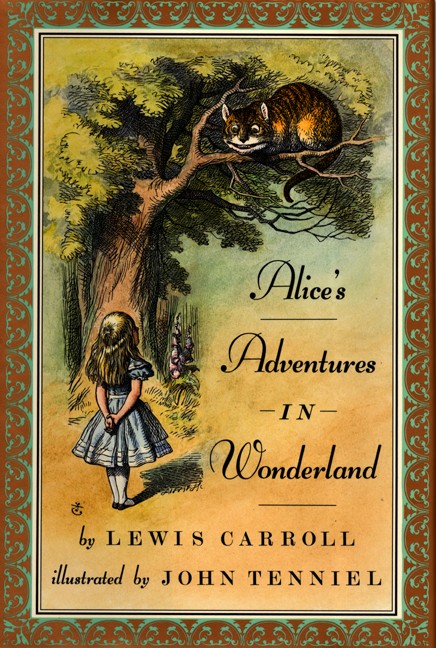
The first topic from my reading list is Age of Innocence. The perfect book to read within this topic is Alice in Wonderland, written by Lewis Carroll. I have never read this book before, but I have seen the movie adaptations when I was younger. Since this is a Disney story, I was fairly interested to read this book. When I was younger I would love the fact that this story is different than other stories. It has talking animals, impossible situations and a queen who likes to cut people’s heads off whenever she feels like it.
When I was younger I did not understand why there were always villains in every story. In this book, this is the Queen of Hearts. She is always angry and mean, if she did not like someone or if she felt a particular way, she would order their heads to be taken off. ‘’The Queen had only one way of settling all difficulties, great or small. ‘Off with his head!’ she said, without even looking round.’’ (Carroll, 2008, p.51). As a child I did not realize this meant that she killed people whenever she felt like it.
Reading this story as an adult has made me confused as to why I used to despise the Queen of Heart so much. I can now understand her perspective more, as she is an insecure woman who has a rival called The Duchess whom everyone loves and adores. The Queen of Hearts fears she will never be as highly praised as her.
As far as Alice’s character goes, I am not sure if she is just a naïve child or if she has more serious problems. She shows no character development as the story ends with her being just as naïve and gullible as she was when the story started, therefore Alice is a static character. She is impulsive, which could seriously harm her if she were to be real. Randomly following a talking rabbit without giving it a second thought, eating mysterious cakes and drinking unknown potions are just three of many irresponsible actions Alice performs. ‘’In another moment down went Alice after it, never once considering how in the world she was to get out again.’’ (Carroll, 2008, p.6). As an adult I would like to see Alice getting a character development. It would, from my point of view, be better if Alice would noticeably learn something from her experiences and actions. The reason this did not happen is because this book is focused on children and children no not like to real about characters with multiple personalities. They prefer simple and easy characters so they know exactly who they are. ‘’The idea of a complex character, with shades of light and dark, is difficult to grasp. For example, the inner feelings of fictional characters do not seem to be of great interest to children at this age.’’ (Appleyard, 1991, p.17). Therefore this book is perfectly suitable for children from ages 7 to 12.
In class I discussed my findings on the book with four people. To my surprise, we mostly had the same opinions. We came to find that we all liked the fact that the book describes specific characters and situations in detail, this helped with having a clear idea of that something looked like. For example, the rabbit is always called the white rabbit. Adding multiple colors enriches one’s fantasy and even sparks creativity. The way it was written forces the reader to use their imagination, which is key when writing children’s books. According to Appleyard (1991, p.4) a growing child needs to know the physical appearance to create an imaginary world.
Just at this moment Alice felt a very curious sensation, which puzzled her a good deal until she made out what it was: she was beginning to grow larger again, and she thought at first she would get up and leave the court; but on second thoughts she decided to remain where she was as long as there was room for her.’’ (Carroll, 2008, p.37).
As the group discussion proceeded we came to the conclusion we all thought Alice is a fairly naïve character who has no problem when talking to anyone and anything. Even when she is talking to herself, she does not make sense. She sings to herself in riddles which are hard to understand. They also contribute nothing to the story’s plot. I can only imagine how confused a child reading this book would be. This is one of the things we dislike about the book. It describes Alice’s unnecessary thoughts and leaves out the important ones.
‘‘How doth the little crocodile
Improve his shining tail,
And pour the waters of the Nile
On every golden scale!
‘How cheerfully he seems to grin,
How neatly spread his claws,
And welcome little fishes in
With gently smiling jaws!’’
(Carroll, 2008, pp. 11-12).
The story’s pattern is repetitive: Alice acts impulsively, this causes for an action to happen, this affects the villain of the story, Alice resolves the problem. The main plot is that the heroes win and the villain, the Queen of Hearts, loses. Appleyard (1991, p.8) states that this is one of the basic story lines one can find in a children’s book. Villains are most often being attacked, chased and defeated. This story however does not focus on parental influences. The main adults present in the story are the Duchess, the Queen of Hearts and the Hatter. However, it can be discussed if the latter could be counted as an adult influence given his state of mind. Although Alice in Wonderland does not suit the reading style of an adult, it still is suitable for children and I think it would positively affect their reading and writing skills, their imagination and their creativity.
S. Kalicharan
Appleyard, J. A. (n.d.). The Reader as Hero and Heroine. Retrieved March 20, 2020, from https://hubl.hu.nl/archive/file/23328
Carroll, L. (2008). Alice’s Adventures in Wonderland [EPub]. Retrieved from file:///C:/Users/Sharinna/Documents/Hogeschool%20Utrecht/Jaar%202/Periode%203/Literature%20II/Books/Innocence/L_Carroll_-_Alice_39_s_Adventures_in_Wonderland[1].pdf
 Sha's blog